

Introduction
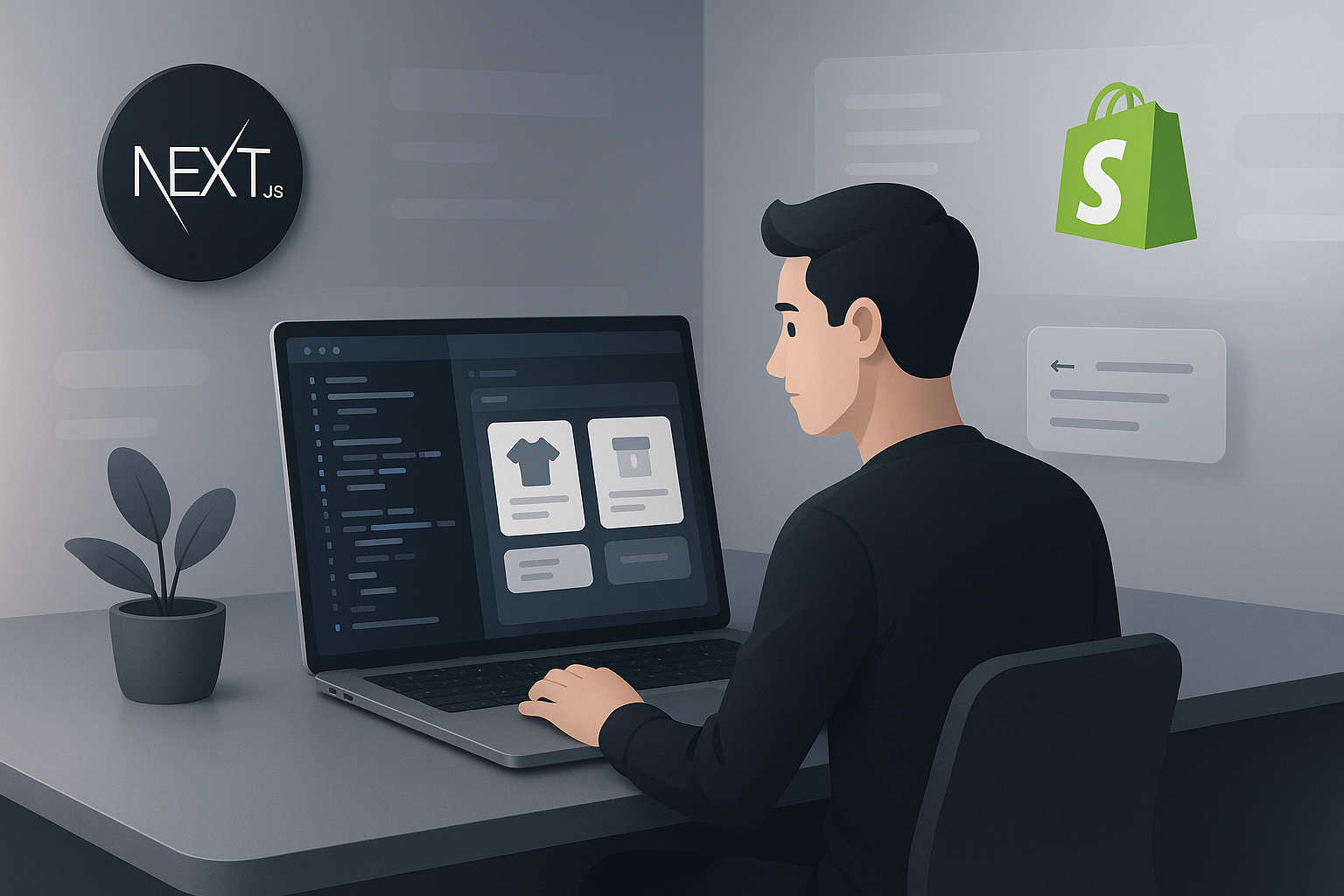
In today’s modern web landscape, speed, flexibility, and scalability define success for eCommerce stores. Traditional Shopify themes, while beginner-friendly, often limit developers looking to create customized, high-performing storefronts. That’s where building a headless Shopify store with Next.js 16 comes in.
In this guide, we’ll walk through how to set up a headless architecture using Next.js 16 and Shopify Storefront API, allowing you to combine Shopify’s powerful backend with the performance and flexibility of a React-based frontend.
What Is a Headless Shopify Store?
A headless Shopify store separates the front end (the website users see) from the Shopify backend (product management, checkout, and inventory). Instead of relying on Shopify’s Liquid templates, developers use modern frameworks like Next.js to build custom interfaces and connect to Shopify through APIs.
This architecture gives you complete control over design, better SEO, faster load times, and improved scalability.
Why Use Next.js 16 for Shopify?
The release of Next.js 16 introduced major improvements, including the React Compiler, enhanced caching, and faster rendering with the App Router. These features make it ideal for building large-scale, data-driven storefronts like Shopify.
Key advantages include:
- Server Components for faster, more efficient rendering
- Built-in caching and revalidation for real-time product updates
- Seamless integration with Shopify APIs
- Static and dynamic page generation for optimal SEO performance
Step 1: Setting Up a New Next.js 16 Project
Start by creating a new Next.js 16 project and installing dependencies.
npx create-next-app@latest shopify-next16-store
cd shopify-next16-store
npm install
Once installed, open your next.config.js file and enable the React compiler:
/** @type {import('next').NextConfig} */
const nextConfig = {
  reactCompiler: true,
  experimental: {
    cacheComponents: true,
  },
};
module.exports = nextConfig;
This configuration ensures maximum performance for your Shopify integration.
Step 2: Getting Your Shopify Storefront API Credentials
- Log into your Shopify Admin Dashboard
- Go to Apps → Develop Apps → Create App
- Under Configuration → Storefront API, enable:
- Read products
- Read product listings
- Read collections
- Copy your Storefront Access Token and Shop Domain
You’ll use these credentials to fetch data securely from Shopify.
Step 3: Connecting Shopify with Next.js
Create a new file called shopify.js inside the lib folder:
const domain = process.env.SHOPIFY_STORE_DOMAIN;
const token = process.env.SHOPIFY_STOREFRONT_ACCESS_TOKEN;

export async function shopifyQuery(query, variables = {}) {
  const response = await fetch(`https://${domain}/api/2025-01/graphql.json`, {
    method: "POST",
    headers: {
      "Content-Type": "application/json",
      "X-Shopify-Storefront-Access-Token": token,
    },
    body: JSON.stringify({ query, variables }),
  });
  const data = await response.json();
  return data.data;
}
Next, create your first query to fetch products:
export const getProducts = async () => {
  const query = `
    {
      products(first: 10) {
        edges {
          node {
            id
            title
            handle
            images(first: 1) {
              edges {
                node {
                  src
                }
              }
            }
          }
        }
      }
    }
  `;
  return await shopifyQuery(query);
};
This function connects your Next.js app directly to Shopify and retrieves product data dynamically.
Step 4: Displaying Products in Next.js
Now, display the products on a page using the App Router in Next.js 16.
Create a file: app/page.js
import { getProducts } from "@/lib/shopify";

export default async function HomePage() {
  const { products } = await getProducts();

  return (
    <main className="grid grid-cols-3 gap-8 p-8">
      {products.edges.map(({ node }) => (
        <div key={node.id} className="border p-4 rounded-lg">
          <img src={node.images.edges[0].node.src} alt={node.title} />
          <h2 className="text-lg font-semibold mt-2">{node.title}</h2>
        </div>
      ))}
    </main>
  );
}
Your headless Shopify store with Next.js 16 is now dynamically fetching and rendering products.
Step 5: Optimizing Performance and SEO
Next.js 16 provides several built-in tools to enhance SEO and performance:
- Use the
<Image />component for optimized images - Generate static pages with Incremental Static Regeneration (ISR)
- Use meta tags in your
layout.jsfor better visibility - Implement server-side rendering (SSR) for dynamic product pages
For image optimization, you can also compress images before uploading using ImageCompressorOnlineFree.com, which helps improve Core Web Vitals and page loading speed.
Step 6: Deploying to Production
Once your store is ready, deploy it with Vercel:
npm run build
npm run start
Connect your GitHub repository to Vercel and set environment variables:
SHOPIFY_STORE_DOMAINSHOPIFY_STOREFRONT_ACCESS_TOKEN
After deployment, you’ll have a blazing-fast, SEO-friendly Shopify storefront powered by Next.js 16.
Internal Link (for Codeblib)
- Next.js 16 Performance Checklist: 10 Must-Do Optimizations for Faster Builds and Runtime
- How to Set Up Serverless Functions in Next.js on Vercel
- Next.js 16 Parallel Routes Breaking Change: The default.js Fix Explained
- Mastering Next.js 16 Build Adapters API: The Key to True Self-Hosting and Custom Deployment
Conclusion
Building a headless Shopify store with Next.js 16 offers unmatched flexibility, scalability, and performance. You get complete control over your storefront design, optimized rendering with React Server Components, and a future-proof architecture built for modern eCommerce.
Whether you’re migrating an existing Shopify store or starting fresh, combining Next.js 16 with Shopify’s Storefront API allows you to build experiences that are faster, more dynamic, and truly developer-friendly.
