

The Visitor Your Store Wasn’t Built For
Picture this: a potential customer opens Aera Browser, types “find me a sustainable water bottle under $40, ships by Friday,” and lets the agent go to work. It visits dozens of stores in seconds. It doesn’t scroll. It doesn’t admire your hero image. It doesn’t feel the pull of your carefully crafted brand story. It reads your data, evaluates your structure, and either recommends your product — or moves on.
This is the new reality of ecommerce. The most consequential visitor to your Shopify store in 2026 may never actually see your store. And if your product pages were built entirely for human shoppers, that agent is probably walking away empty-handed.
The question isn’t whether AI agents are coming to your storefront. They’re already there. The question is what they find when they arrive.
What Aera Browser Actually Is — And What It Does on Your Store
Aera isn’t a chatbot bolted onto a browser. It’s a fundamentally different class of software: an autonomous execution engine that treats the browser itself as an operating system for agents. Where traditional AI tools suggest what to do, Aera does it — clicking, querying, evaluating, and acting on a user’s behalf across the full web.
When Aera visits a Shopify store, it runs a structured process. It analyzes the page and extracts actionable elements, then interacts with those elements intelligently — querying product data, reading specifications, checking inventory, and deciding whether your product is worth recommending. It doesn’t browse. It processes.
And here’s the uncomfortable truth: a store can look perfect to a human visitor and still be almost entirely unreadable to Aera.
How AI Agents Experience a Product Page vs. How Humans Do
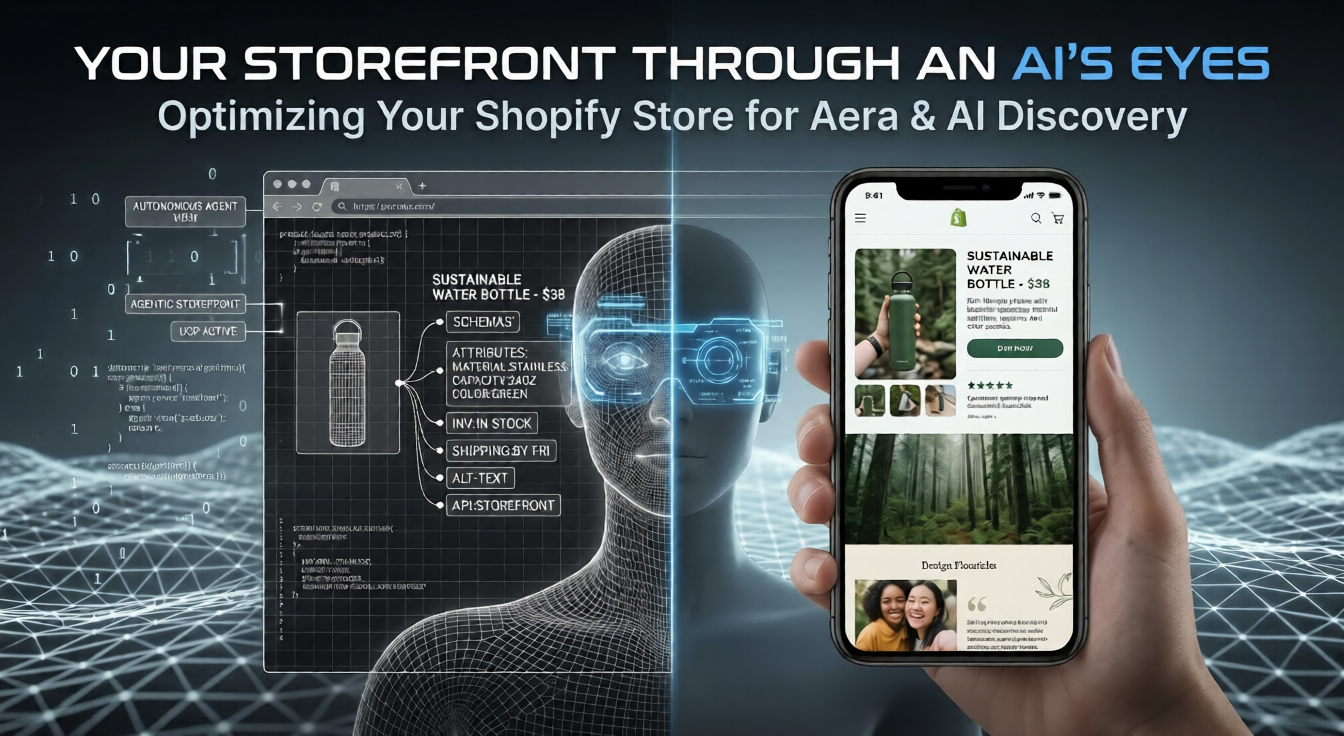
When a human lands on your product page, they take in the full sensory experience — photography, typography, layout, social proof, the feel of the brand. When an AI agent lands on the same page, it experiences something much more austere.
The agent reads your structured data. It parses your schema markup. It queries your API responses. It processes your alt text. Everything else — the lifestyle photography, the hover animations, the parallax scroll effects, the video banner — is either invisible or irrelevant to the decision being made.
This isn’t a limitation that will be patched in the next update. It’s the fundamental nature of how agents interact with the web. And it means that the gap between “looks great” and “is agent-ready” is wider than most Shopify merchants realize.
The 4 Things Aera Sees — And the 4 Things It Misses
What Agents Read
AI agents like Aera evaluate your store through a narrow but precise lens. They read:
Structured data and schema markup — Product schema, Offer schema, AggregateRating, FAQPage. This is the machine-readable layer that tells an agent not just what’s on the page, but what it means. That $89 is a price. That 4.7/5 is a customer rating. That In Stock is inventory status.
API responses — For headless and MCP-connected stores, agents query your Storefront API directly, bypassing the visual layer altogether. The quality of your product data at the API level is what determines whether an agent can confidently recommend you.
Alt text — Images are invisible to agents in the way they’re visible to humans. But alt text isn’t. A well-written alt attribute is one of the few ways your product photography actually communicates to a machine.
Raw HTML content — Whatever exists in the initial HTML payload before JavaScript executes. If your product title, price, and description are in the HTML, agents can read them. If they load via JavaScript after the page renders, they probably can’t.
What Agents Skip
This is where most Shopify stores fall short. Agents are effectively blind to:
JavaScript-rendered content — Most AI crawlers cannot render JavaScript. Any product information that loads client-side — dynamic pricing, variant details, review summaries, “frequently bought together” sections — is invisible to the agent. If your product data lives in Liquid templates or JavaScript rendering logic, it’s hidden from AI.
Visual design elements — Animations, layout, whitespace, photography, video. The visual identity that took months to craft is entirely irrelevant to an agent’s recommendation decision.
Emotional copywriting without specifics — “Feel the freedom of the open road” tells an agent nothing. It cannot extract a purchasing attribute from an evocative phrase. Impressionistic language is, from the agent’s perspective, noise.
Navigation and UX flows — Agents don’t explore your site the way humans do. They don’t follow the customer journey you’ve designed. They extract what they need from the data layer and leave.
The 4 Failure Modes That Get a Product Skipped Entirely
After auditing dozens of Shopify stores for agentic readiness, four patterns consistently cause AI agents to either skip a product entirely or make incorrect recommendations:
1. Attribute ambiguity — Product descriptions written in emotional or impressionistic language that doesn’t specify key purchasing attributes. Agents need facts, not feelings, to make confident recommendations.
2. Variant confusion — Using separate product pages for each variant of a product. An agent encountering three pages for the same shoe in different colors assumes they’re three different products. When a potential customer asks “does this come in blue?”, the agent may give the wrong answer entirely.
3. Inventory inaccuracy — For AI agents, an out-of-stock recommendation is a trust-breaking failure. Agents that recommend unavailable products are rated poorly by users and deprioritized in future queries. Real-time inventory sync is no longer optional.
4. Data sparsity — Titles and prices alone are insufficient for AI-driven commerce. Agents require dense attribute data — materials, dimensions, compatibility, use cases — to match products to natural-language queries. Sparse product pages simply don’t enter consideration.
Why This Is a Shopify Problem Right Now
AI-Driven Orders Grew 15x — And the Race Is Already On
This isn’t a future-state scenario. AI-driven orders grew 15x year-over-year through 2025, and the platforms enabling this shift are already live. ChatGPT, Microsoft Copilot, Google AI Mode, and Perplexity all have active shopping features powered by autonomous agents. AI platforms are projected to account for $20.57 billion in US retail ecommerce sales in 2026 alone — nearly quadruple the 2025 figure.
The more unsettling data point: only 12% of URLs cited by AI tools overlap with Google’s top 10 results. Years of SEO investment, content strategy, and paid search optimization do not automatically translate to AI visibility. The hierarchy AI uses to decide which brands to recommend is being built right now — and it doesn’t mirror search rankings.
Brands that aren’t structuring their product data for agents today are ceding ground that will compound against them month after month.
How Shopify Agentic Storefronts and UCP Change the Game
Shopify has moved faster than most merchants realize. As part of the Winter ’26 Edition, Shopify introduced Agentic Storefronts — a one-time setup in your admin that syndicates your products to ChatGPT, Perplexity, Microsoft Copilot, and Google AI Mode simultaneously, with no bespoke integrations required.
The infrastructure layer beneath this is the Universal Commerce Protocol (UCP), co-developed by Shopify and Google — an open standard that enables AI agents to interact with your catalog, cart, and checkout through a unified framework. When a shopper’s agent asks ChatGPT for “the best trail running shoes under $150 available for Friday delivery,” UCP is the protocol that lets the agent query your store, verify inventory, and surface your product natively in the conversation.
The catch: Agentic Storefronts give agents access to your store. Optimizing your product data is what determines whether that access results in a recommendation.
The Hidden Advantage of Headless Architecture
There’s a meaningful architectural edge for merchants who’ve invested in headless. Headless Shopify — using the Storefront API with a custom frontend in Next.js, Nuxt, or Hydrogen — gives you direct control over your API layer, which is exactly what agents interact with. Liquid themes require HTML parsing, deliver slower response times, and offer limited structured data control.
If you’ve been weighing the move to headless, agentic commerce has changed the calculus. A headless Shopify store built with Next.js isn’t just a frontend upgrade — it’s increasingly a prerequisite for full agentic readiness. Hydrogen 2026.1.4 now ships with built-in Storefront MCP proxy support, meaning every Hydrogen store can expose an MCP endpoint at /api/mcp with zero custom setup. Your storefront becomes a first-class agent endpoint by default.
For merchants still on Liquid themes, your Shopify theme may already be limiting your visibility in ways you haven’t fully audited. The JavaScript rendering limitations of traditional Shopify themes are exactly the kind of silent failure that makes product data invisible to AI agents — while everything looks perfectly fine to a human visitor.
The Aera UX Audit: 6 Areas to Check Today
This is the practical part. Run your store against each of these six areas. For every gap you find, you’re looking at a product that agents are currently skipping.
1. Product Descriptions — Facts First, Feelings Second
The most common mistake in Shopify product copy is leading with the emotional benefit and burying the technical specifications. Human copywriters have been trained this way for decades. AI agents process content roughly in the order they encounter it, weighting earlier content more heavily — which means your most important purchasing attributes need to come first.
The model: lead with facts, follow with feeling.
Instead of a description like “beeswax candle, 8 oz., cotton wick,” write for both audiences simultaneously: “A gender-neutral scent, made with beeswax, 50-hour burn time, suited for home offices or living rooms.” The facts are front-loaded and specific. The emotional context follows. Both the agent and the human get what they need.
For every product, ask: what questions would an AI agent need answered to confidently recommend this? Material, dimensions, use case, compatibility, fit, weight — whatever is relevant to how a customer would filter for your product in a natural language query. If those answers aren’t in the first 100 words of your description, they may not be read at all.
2. Schema Markup — Beyond the Basics
Most Shopify themes include basic Product schema — enough to generate a price in a Google rich snippet. It’s no longer sufficient. For AI agent visibility, you need comprehensive JSON-LD that includes Product, Offer, Review, AggregateRating, and FAQPage schema.
The FAQPage schema deserves special attention. Princeton GEO research confirms it’s one of the highest-impact schema types for AI citation. When your product’s common questions are marked up as structured FAQ data, agents can extract and serve those answers directly in conversational responses — without the user ever needing to click through to your store.
Validate your current schema with Google’s Rich Results Test. Most Shopify stores will find gaps in AggregateRating and Offer completeness. Fix those first.
3. Structured Tags — Namespace:Value Patterns for Machine Precision
Shopify tags are one of the most underused tools in the agentic optimization toolkit. Most merchants use them as loose marketing labels: “summer,” “bestseller,” “gift-idea.” For AI agents, this is nearly useless.
Think of tags not as marketing labels but as attribute-value pairs for machines. Instead of tagging a product “breathable” and “summer,” tag it season:summer, breathability:high, material:linen, fit:relaxed. This namespace:value pattern allows agents querying via MCP to filter by specific attributes with precision. A buyer who says “find me breathable linen trousers in a relaxed fit” maps cleanly to material:linen + breathability:high + fit:relaxed. Without structured tags, the agent has to parse body copy — which is slower, less accurate, and more likely to produce a wrong result.
This is one of the highest-leverage changes you can make with no development work required.
4. Inventory Accuracy — Real-Time or Irrelevant
For AI agents, inventory accuracy is a trust problem. An agent that recommends an out-of-stock product hasn’t just made a mistake — it’s broken trust with the user who delegated the task to it. Those agents are rated down and deprioritized for future queries.
Audit your inventory sync frequency. If there’s a delay between your warehouse and your Shopify product pages, agents operating on stale data will make bad recommendations on your behalf. Direct API access via Shopify Catalog is the most reliable solution — it gives agents access to the most up-to-date and accurate information in real time, bypassing the display layer entirely.
Also check your variant structure. If you’re running separate product pages for each colour or size variant, group them under a single parent product with proper variant configuration. An agent needs to understand that these are options within one product — not separate competing listings.
5. AI Crawler Access — Check Your robots.txt
This is the silent failure that nobody catches until they audit it. Many Shopify stores have robots.txt files configured to block scrapers — and those rules are inadvertently blocking legitimate AI crawlers too.
Check your robots.txt for blocks on GPTBot, ClaudeBot, and PerplexityBot. If any of these are disallowed, your store is invisible to the AI platforms those bots feed. Making a deliberate decision about which AI crawlers to allow isn’t optional — it’s now a strategic choice about which sales channels you participate in.
For headless implementations, your robots.txt route handler needs to explicitly allow these user agents. For standard Shopify stores, review your theme settings and any SEO apps that may be generating overly restrictive crawl rules.
6. FAQ Layer — How Agents Answer Brand Questions
When a shopper’s agent is evaluating your store, it’s not just looking at product attributes. It’s also trying to answer the questions a buyer would ask before committing: What’s the return policy? How long does shipping take? Is this brand verified? Do they ship internationally?
Adding a dedicated FAQ section is one of the most effective content structures for AI discoverability. Semrush’s research confirms that Q&A formatting is one of the formats AI answer engines crawl and reference most reliably. Dense paragraphs in your page footer don’t cut it.
Shopify’s free Knowledge Base app lets you structure your store’s policies, shipping information, and brand FAQs in a format that AI platforms can index and reference accurately. Set it up. Fill it out. Think about every question a cautious buyer might ask, and make sure the answer exists in a structured, crawlable format.
The Compounding Advantage of Acting First
There’s a pattern emerging in agentic commerce that mirrors the early days of SEO — and it should feel urgent.
Stores visible in AI shopping are accumulating clicks, reviews, and indexing signals right now. Those signals make them harder to displace with each passing month. Agents that successfully recommend a product build confidence in that product. That confidence feeds forward into future queries. The stores that optimized early in 2010 built compounding search advantages that took competitors years to overcome. The same dynamic is playing out in agentic commerce today — compressed into a much shorter window.
The brands winning this shift aren’t waiting. They’re auditing how agents see them, fixing their data, and configuring their storefronts for the channel that’s already driving the highest-intent, highest-conversion traffic in ecommerce. AI-driven traffic converted 38% better than traditional sources during Black Friday 2025. Agents only initiate a purchase when intent is high and the data supports a confident recommendation.
The gap between agent-ready and agent-invisible is growing every week. The question for your store isn’t whether to close it — it’s how quickly you move.
Ready to see your Shopify store through an AI’s eyes? Get in touch and let’s run a full agentic UX audit on your store together.
