

Introduction: The New Frontier of Search
As voice technology continues to evolve, the way people interact with the web is changing dramatically.
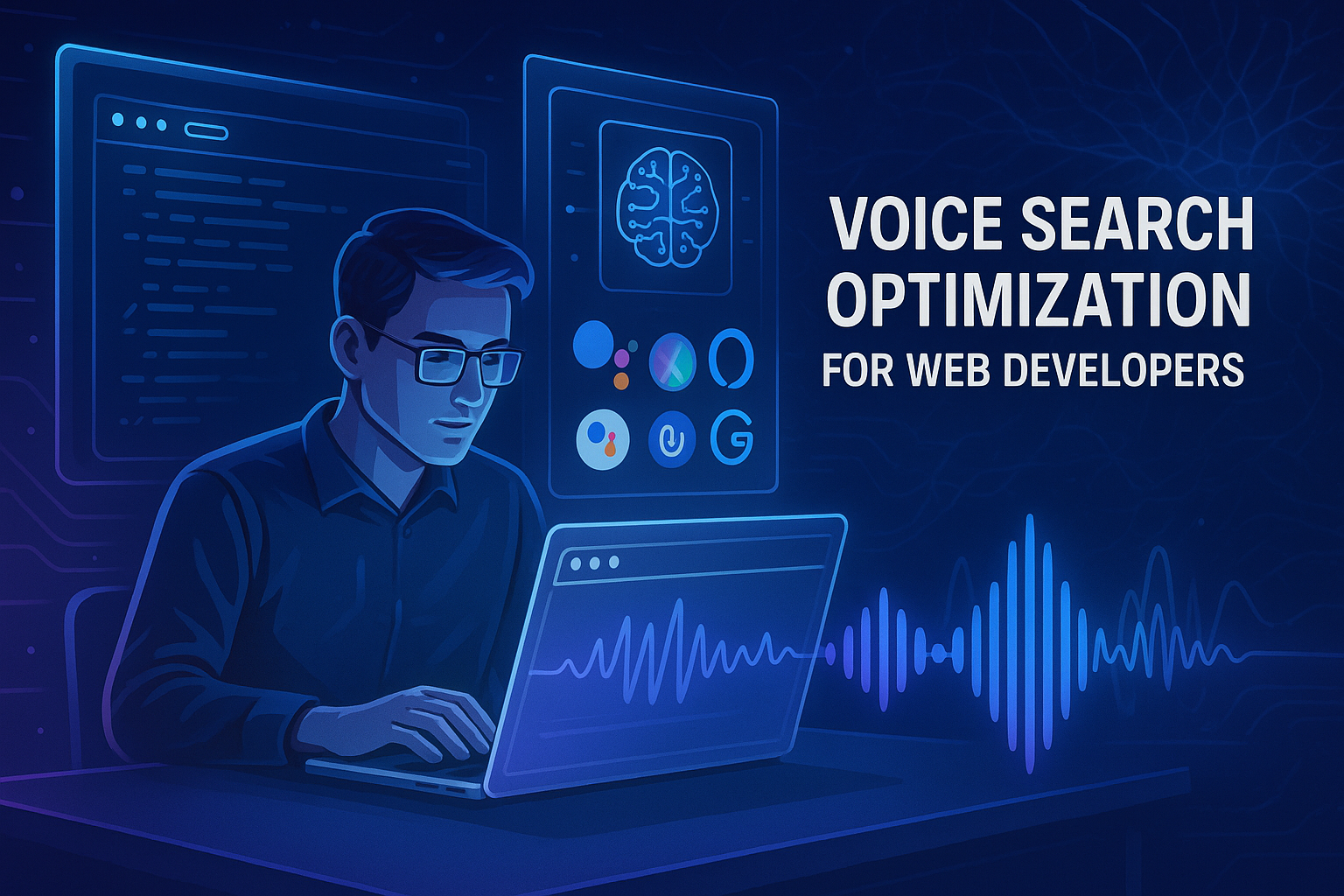
Users are no longer just typing, they’re talking. This shift has given rise to Voice Search Optimization (VSO), the practice of tailoring websites and content to perform better for voice-based queries made through AI-powered assistants like Google Assistant, Alexa, Siri, and Gemini.
For web developers, this means a new challenge:
How do you build websites that “speak the same language” as AI assistants?
Let’s explore how conversational AI, NLP (Natural Language Processing), and modern web technologies are reshaping SEO and what developers can do to stay ahead.
The Role of AI and NLP in Voice Search
Artificial Intelligence (AI) is at the heart of voice search.
With Natural Language Processing (NLP), search engines can now understand human intent, tone, and conversational context — far beyond simple keywords.
Here’s what that means for search behavior:
- Contextual Understanding: AI identifies what users mean, not just what they say.
- Conversational Queries: Instead of “weather Karachi,” users say, “What’s the weather like in Karachi today?”
- Personalized Results: AI tailors answers based on history, location, and preferences.
- Continuous Learning: Voice assistants improve with every interaction, refining responses through machine learning.
For web developers, this evolution means websites must become contextually smart and linguistically adaptive, ready to respond to natural, question-based searches.
How Voice Search Is Changing Web Development
In the age of conversational AI, traditional SEO tactics aren’t enough. Developers now play a critical role in optimizing site structure, performance, and accessibility for voice-driven experiences.
Key transformations include:
- Question-based content: Voice queries sound more like natural sentences.
→ Developers should structure content using FAQ sections and semantic markup. - Speed-first design: Voice users expect instant results.
→ Optimize Core Web Vitals — reduce server response times and improve LCP (Largest Contentful Paint). - Schema Markup Integration: Helps search engines understand your content.
→ Implement JSON-LD for FAQs, How-tos, and product details. - Mobile-first optimization: Most voice searches come from mobile.
→ Ensure responsive design and lightning-fast performance on all devices. - Accessible Web Experiences: Voice search aligns with accessibility standards (ARIA roles, proper headings).
→ Build inclusive, assistive-device-friendly sites.
Voice Search Optimization Strategies for Developers
To make your website truly voice-friendly, integrate these technical SEO and AI-aligned best practices:
1. Implement Structured Data (Schema Markup)
Use Schema.org markup to help search engines understand your page context.
<script type="application/ld+json">
{
  "@context": "https://schema.org",
  "@type": "FAQPage",
  "mainEntity": [{
    "@type": "Question",
    "name": "How can web developers optimize for voice search?",
    "acceptedAnswer": {
      "@type": "Answer",
      "text": "Web developers can implement structured data, optimize for mobile speed, and create conversational content for better voice search visibility."
    }
  }]
}
</script>
✅ Boosts chances of being selected for featured snippets, the source for most voice results.
2. Optimize for Conversational Queries
Instead of short-tail keywords like:
“SEO strategies”
Use long-tail, conversational phrases such as:
“What are the best SEO strategies for web developers?”
This mirrors how people actually speak when using voice assistants.
3. Build for Speed and Mobile
Use these practices to ensure your site responds fast:
- Lazy-load images and scripts
- Use a CDN (Content Delivery Network)
- Minify CSS, JS, and HTML
- Implement caching with Service Workers
- Optimize for Core Web Vitals
Voice search users are usually on-the-go, so speed = visibility.
4. Write with a Conversational Tone
Even as a developer, content matters.
Voice search favors content that sounds human and natural.
Use:
- Direct answers under 50 words
- FAQs with “how,” “what,” “when,” “where” questions
- Headings formatted like conversational queries
5. Use NLP and AI Tools for Content Insights
Developers can leverage AI-powered tools to analyze conversational queries:
- Google Search Console → See long-tail queries
- AnswerThePublic → Find voice-like questions
- ChatGPT or Gemini → Generate conversational keyword ideas
These tools help you align your content with AI-driven search patterns.
Real-World Examples of Voice Optimization
1. Google Assistant
Uses BERT and Gemini AI models to interpret complex language patterns.
Sites optimized for structured data and conversational content perform best.
2. Alexa
Integrates with businesses for voice-commerce, ordering products through speech.
Voice-optimized eCommerce sites see higher engagement.
3. Siri
Uses on-device intelligence to provide local and context-aware results.
Websites with strong local SEO and mobile performance benefit the most.
4. Gemini
Google’s next-gen AI system combining voice, text, and visuals.
Optimized sites can leverage multimodal experiences, an evolving SEO opportunity.
Future of Voice Search and Web Development
By 2030, websites won’t just be read, they’ll be heard.
Developers will design experiences that interact naturally with AI assistants and IoT devices.
Future predictions:
- Voice-first UI: Websites with integrated speech recognition APIs.
- Conversational AI integration: AI chat widgets and assistant APIs.
- Hyper-personalized search: AI predicting user intent before a query.
- Zero-interface design: Voice replacing screens in certain experiences.
Developers who adapt now will lead the next generation of voice-driven web innovation.
🔗 Internal Link Suggestions (for Codeblib)
- Voice Search Optimization: How AI Is Changing Search Behavior
- Optimizing Websites for Web Vitals: A Step-by-Step Guide
- How to Improve Google PageSpeed Score with Smart Image Optimization
Conclusion: Build for the Voices of Tomorrow
The future of the web is conversational.
As Voice Search Optimization becomes essential, developers must go beyond keywords, building fast, structured, and AI-compatible experiences that answer human questions naturally.
So if you’re a web developer aiming to future-proof your sites:
🎯 Start optimizing today, for a world where search is spoken, not typed.
🚀 Build voice-friendly. Build for the future.
