
Close Menu
    Facebook X (Twitter) Instagram
    • About
    • Privacy Policy
    • Contact Us
    Tuesday, November 11
    Facebook X (Twitter) Instagram
    codeblib.comcodeblib.com
    • Web Development

      Building a Headless Shopify Store with Next.js 16: A Step-by-Step Guide

      October 28, 2025

      Dark Mode the Modern Way: Using the CSS light-dark() Function

      October 26, 2025

      The CSS if() Function Has Arrived: Conditional Styling Without JavaScript

      October 24, 2025

      Voice Search Optimization for Web Developers: Building Voice-Friendly Websites in the Age of Conversational AI

      October 20, 2025

      Voice Search Optimization: How AI Is Changing Search Behavior

      October 19, 2025
    • Mobile Development

      The Future of Progressive Web Apps: Are PWAs the End of Native Apps?

      November 3, 2025

      How Progressive Web Apps Supercharge SEO, Speed, and Conversions

      November 2, 2025

      How to Build a Progressive Web App with Next.js 16 (Complete Guide)

      November 1, 2025

      PWA Progressive Web Apps: The Secret Sauce Behind Modern Web Experiences

      October 31, 2025

      Progressive Web App (PWA) Explained: Why They’re Changing the Web in 2025

      October 30, 2025
    • Career & Industry

      AI Pair Programmers: Will ChatGPT Replace Junior Developers by 2030?

      April 7, 2025

      The Rise of Developer Advocacy: How to Transition from Coding to Evangelism

      February 28, 2025

      Future-Proofing Tech Careers: Skills to Survive Automation (Beyond Coding)

      February 22, 2025

      How to Build a Compelling Developer Portfolio: A Comprehensive Guide

      October 15, 2024

      The Future of Web Development: Trends to Watch in 2025

      October 15, 2024
    • Tools & Technologies

      Top 10 Use-Cases of Aera Browser for Developers

      November 11, 2025

      How Aera Browser Enables No-Code Automation for Marketers

      November 9, 2025

      The AI Browser War: Aera Browser vs Atlas Browser

      November 7, 2025

      Cursor 2.0 Released: Faster, Smarter, and More Agentic Than Ever

      November 6, 2025

      Aera Browser: The AI-Powered Revolution Changing How We Browse the Web

      November 4, 2025
    codeblib.comcodeblib.com
    Home»Tools & Technologies»Google Opal vs N8N on Conversational Simplicity and Deep API Control
    Tools & Technologies

    Google Opal vs N8N on Conversational Simplicity and Deep API Control

    codeblibBy codeblibOctober 27, 2025No Comments4 Mins Read
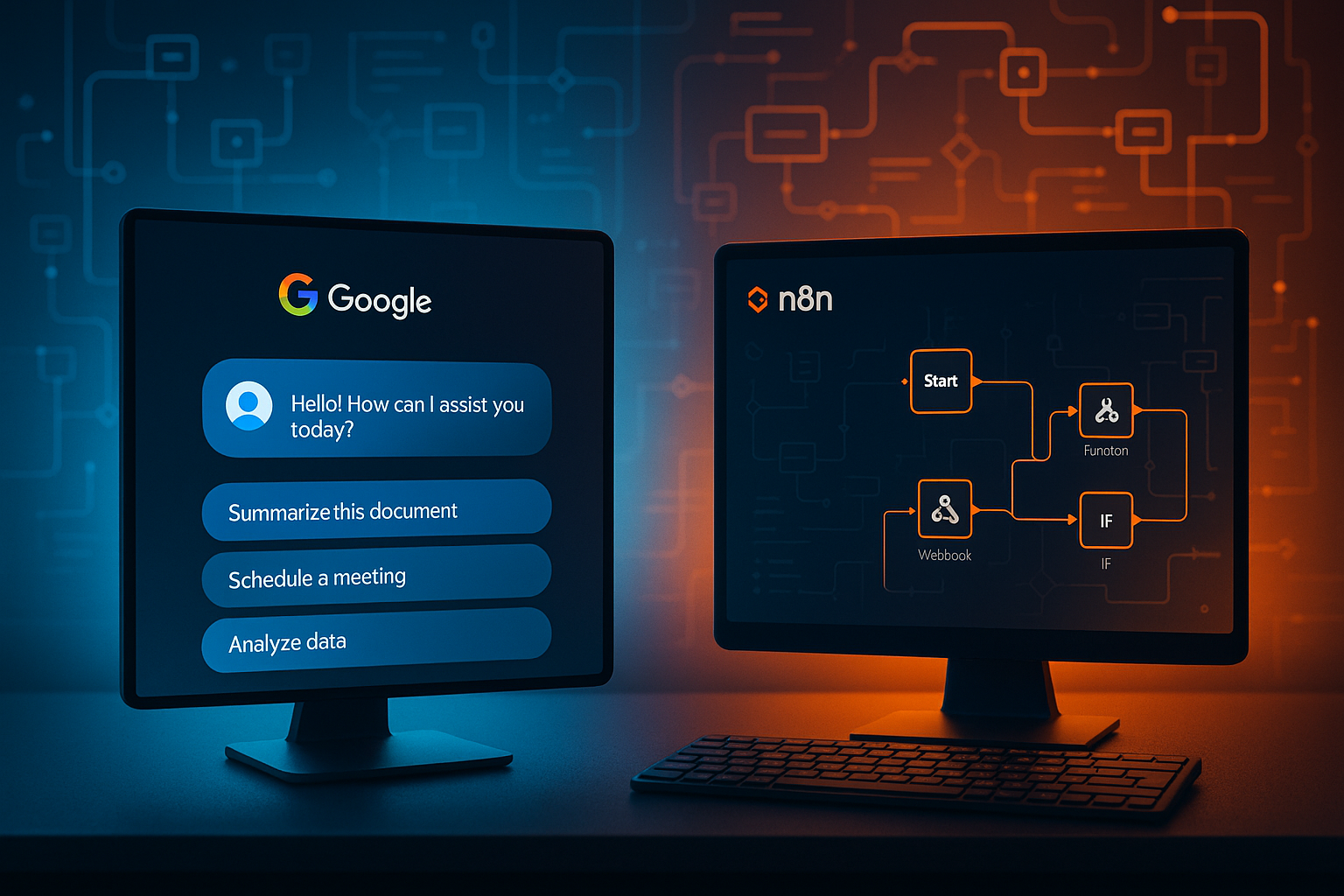
    Google Opal vs N8N: The battle between conversational simplicity and developer-level automation control.
    Google Opal vs N8N: The battle between conversational simplicity and developer-level automation control.
    Share
    Facebook Twitter LinkedIn Pinterest Email Copy Link

    Introduction: The Great Divide in AI Workflow

    Google Opal vs N8N: The automation world is changing fast. Today, two very different philosophies dominate the space:

    • Google Opal, built for simplicity, anyone can describe what they want in plain English, and the AI does the rest.
    • n8n, built for control, it gives developers a playground to build complex, custom, and self-hosted workflows.

    So the real question isn’t which tool is better, but which one is better for you.

    Opal’s mission is to make AI app creation accessible to non-technical users, perfect for teams that just want results without coding.
    Meanwhile, n8n empowers developers and enterprises who need precision, flexibility, and ownership of their automation logic and data.

    Let’s break down how these two tools compare in usability, customization, and real-world deployment.

    Usability and Interface Comparison

    Conversational Simplicity (Google Opal)

    Imagine describing your workflow like you’d talk to a colleague:

    “Send a summary of today’s emails to Slack, and create a Trello card if something is marked urgent.”

    That’s exactly what Google Opal does. You speak (or type) what you want, and the AI automatically builds your flow visually.

    It’s intuitive, beginner-friendly, and requires zero setup. Perfect for marketers, content creators, or business users who want quick automations without diving into code or logic trees.

    ✅ Best for: non-technical users, quick prototypes, and creative AI experiments.

    Node-Based Logic (n8n)

    n8n takes the opposite approach. It gives you a node-based UI, a visual editor where each node represents an action, trigger, or condition.

    It’s more technical, yes, but also much more powerful. Developers can handle complex workflows, add custom code, and integrate APIs from nearly any platform.

    Think of it as an automation “command center”, where you can see, debug, and refine every single step.

    ✅ Best for: developers, automation engineers, and teams that need deep logic and control.

    Control, Customization, and Complexity

    Handling Multi-Step and Complex Workflows

    If your automation involves multiple branches, loops, or conditional paths, n8n is built for that.
    You can create layered, multi-step processes that integrate multiple APIs and data streams, all inside your own environment.

    Google Opal, on the other hand, keeps things simple. It’s great for linear or straightforward automations, but it struggles with highly branched or conditional logic.

    ✅ Verdict:

    • Google Opal → great for simple, single-purpose flows.
    • n8n → unbeatable for complex, multi-layered workflows.

    Deep API Integrations and Flexibility

    n8n offers hundreds of built-in integrations, supports REST and GraphQL, and even lets you code custom nodes.
    That means you can connect anything, CRMs, databases, or internal APIs, all while keeping full developer control.

    Meanwhile, Google Opal is still young. It mainly supports Google ecosystem tools like Gmail, YouTube, and Drive. Integrating third-party services often requires manual setup or API registration.

    ✅ Verdict:

    • n8n: deep, flexible integrations for serious developers.
    • Opal: quick and easy, but limited beyond Google apps.

    Deployment and Data Sovereignty

    Open-Source Flexibility and Self-Hosting (n8n)

    One of n8n’s biggest strengths is its open-source nature. You can self-host it anywhere, your cloud, your server, or even locally.
    This means:

    • Full data control
    • Complete customization
    • Better security for sensitive information

    For enterprises and automation companies, that’s a dealbreaker advantage.

    Vendor Dependence and “Experimental” Status (Google Opal)

    Google Opal is still in Google Labs, which means it’s experimental. You can’t self-host it, and it fully relies on Google’s infrastructure.

    While that makes setup easy, it also means:

    • You depend on Google’s ecosystem
    • You can’t access your workflow data directly
    • Future pricing or feature changes could affect your setup

    ✅ Verdict:
    If data ownership, compliance, and customization matter → n8n wins hands down.

    Conclusion: Which Platform Should You Choose?

    Let’s make it simple 👇

    User TypeBest ChoiceWhy
    🧍‍♂️ Non-technical usersGoogle OpalFast setup, conversational UI, no coding needed
    👨‍💻 Developers / Engineersn8nFull control, self-hosting, advanced logic
    🏢 Enterprisesn8nSecure, scalable, open-source flexibility
    💡 Creators / MarketersGoogle OpalGreat for quick prototypes & creative workflows

    ✅ Final Verdict

    If you want speed, simplicity, and creativity, go with Google Opal.
    If you want power, flexibility, and total control, n8n is the clear winner.

    Both tools are shaping the future of automation, one through conversation, and the other through control.

    🔗 Internal Link Suggestions (for Codeblib)

    • Why the AI Browser Race Matters in 2025: Atlas vs Chrome vs Edge
    • OpenAI’s ChatGPT Atlas Browser: How It Could Redefine Web Search in 2025
    ai ai automation n8n
    Share. Facebook Twitter Pinterest LinkedIn Tumblr Email Copy Link
    Unknown's avatar
    codeblib

    Related Posts

    Top 10 Use-Cases of Aera Browser for Developers

    November 11, 2025

    How Aera Browser Enables No-Code Automation for Marketers

    November 9, 2025

    The AI Browser War: Aera Browser vs Atlas Browser

    November 7, 2025

    Cursor 2.0 Released: Faster, Smarter, and More Agentic Than Ever

    November 6, 2025

    Aera Browser: The AI-Powered Revolution Changing How We Browse the Web

    November 4, 2025

    Google Opal Explained: Build AI Mini-Apps Without Writing Code

    October 29, 2025
    Add A Comment

    Comments are closed.

    Categories
    • Career & Industry
    • Editor's Picks
    • Featured
    • Mobile Development
    • Tools & Technologies
    • Web Development
    Latest Posts

    React 19: Mastering the useActionState Hook

    January 6, 2025

    Snap & Code: Crafting a Powerful Camera App with React Native

    January 1, 2025

    Progressive Web Apps: The Future of Web Development

    December 18, 2024

    The Future of React: What React 19 Brings to the Table

    December 11, 2024
    Stay In Touch
    • Instagram
    • YouTube
    • LinkedIn
    About Us
    About Us

    At Codeblib, we believe that learning should be accessible, impactful, and, above all, inspiring. Our blog delivers expert-driven guides, in-depth tutorials, and actionable insights tailored for both beginners and seasoned professionals.

    Email Us: info@codeblib.com

    Our Picks

    Top 10 Use-Cases of Aera Browser for Developers

    November 11, 2025

    How Aera Browser Enables No-Code Automation for Marketers

    November 9, 2025

    The AI Browser War: Aera Browser vs Atlas Browser

    November 7, 2025
    Most Popular

    The Future of Progressive Web Apps: Are PWAs the End of Native Apps?

    November 3, 2025

    How Progressive Web Apps Supercharge SEO, Speed, and Conversions

    November 2, 2025

    How to Build a Progressive Web App with Next.js 16 (Complete Guide)

    November 1, 2025
    Instagram LinkedIn X (Twitter)
    • Home
    • Web Development
    • Mobile Development
    • Career & Industry
    • Tools & Technologies
    © 2025 Codeblib Designed by codeblib Team

    Type above and press Enter to search. Press Esc to cancel.